Selecting Where You Live: The Case for Designing Your Life

One of the things very few people do is to intentionally choose where they live. If you are making that choice, I have a tool that when used as part of a broader decision model, can prepare you to make a wise and thoughtful choice for your next move.
A few years ago, my wife and I began to feel open to moving to a new home in a new city—we were ready for a new adventure. Wanting to be thoughtful and careful about making our choice of where we would land, we put on paper the things we already knew mattered to us about every and any place we live.
The Location Alignment Tool
This Location Alignment Tool was a spreadsheet we developed to collect information, identify our values and then make comparisons across cities. (See the full spreadsheet model in our Location Alignment tool template).
Here is a brief excerpt of this model which in total has 63 rows:
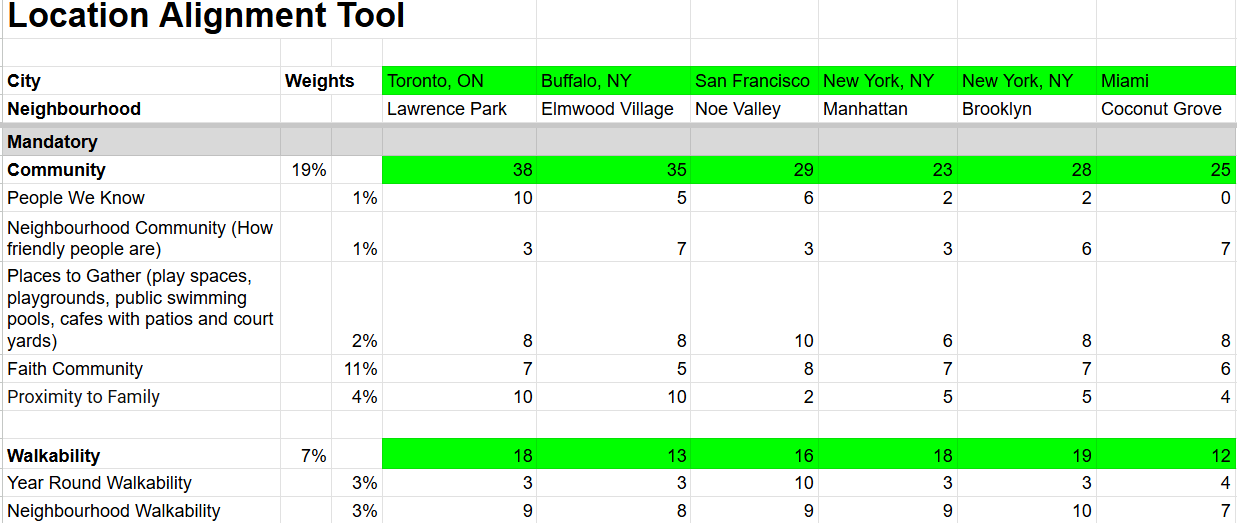
Top of this list was a broad category called "community," which for us meant having access and proximity to people we know, a locale where neighbours could gather, and a familiar faith atmosphere.
We also included more measurable aspects like walkability and transit; types of schools; weather; proximity to natural beauty; diversity; culture; professional benefits; and cost of living.
Next, we developed a system to score and compare each of our potential locations.
Some of the information was easy to find; some websites and real estate listings offer walkability ratings, for instance.
However, some of our criteria were more qualitative and required visits and intentional conversations. For example, it is important to our family that we live in a community near and open to refugees, the disadvantaged, or newcomers to the country. Diverse communities can reduce the “insider/outsider” vibe that is invisible but real in many homogenous environments—and that we wanted to avoid.
So we traveled and visited a number of cities and wrote down our observations.
Collecting analytical data was only part of the process, however; we discovered that such a significant decision required and benefitted from using a multi-stage decision model.
The Moving Decision Model
Step 1: Decision to explore a move. This was a big step where we prayerfully considered if we wanted to embark on this discovery journey.
Step 2: The analytical stage where we put our values on paper and did the needed research using the Location Alignment Tool. This tool gave us increased clarity on potential places we could live.
Step 3: The spiritual stage, where we prayed, hands open, and asked God, if God so chose, to speak to us and give us more clarity. We were happy to stay where we were, and equally content to move to where our Location Alignment Tool pointed or to somewhere else entirely.
The third step was very important for us. We can do all the analysis in Step 2 but felt in our decision making process we wanted increased clarity from someone outside of ourselves.
In our story, we both had a spiritual experience where God gave us clarity and we were one-hundred-percent clear that San Francisco was meant to be our next home.
I offer these two resources of the Location Alignment Tool and the Moving Decision Model and hope they can be helpful in your decision making.